

Sep. 09, 2026
A Portable Backpack Laser Cleaning Machine is designed for situations where traditional stationary laser cleaning equipment is difficult to transport or where operators need to clean surfaces directly at the job site. Its compact, portable design allows users to carry the laser cleaning system to different locations and remove rust, paint, oil, oxide layers, dirt, and other surface contaminants from metal components.
Unlike conventional chemical cleaning, abrasive blasting, or mechanical grinding, laser cleaning uses a controlled laser beam to remove unwanted materials from the surface. The process can provide precise, contactless, and relatively low-consumption surface cleaning without requiring physical contact between the cleaning tool and the workpiece.
The primary purpose of a portable backpack laser cleaning machine is on-site surface preparation and contaminant removal.
It is particularly useful when components are too large, heavy, fixed in place, or difficult to transport to a conventional cleaning station.
Typical applications include:
Rust removal
Paint removal
Oil and grease removal
Oxide removal
Surface dirt cleaning
Coating removal
Weld preparation
Weld seam cleaning
Mold cleaning
Metal surface preparation
Industrial equipment maintenance
The backpack configuration makes it easier for operators to move around large structures, production areas, construction sites, maintenance workshops, and other locations where mobility is important.
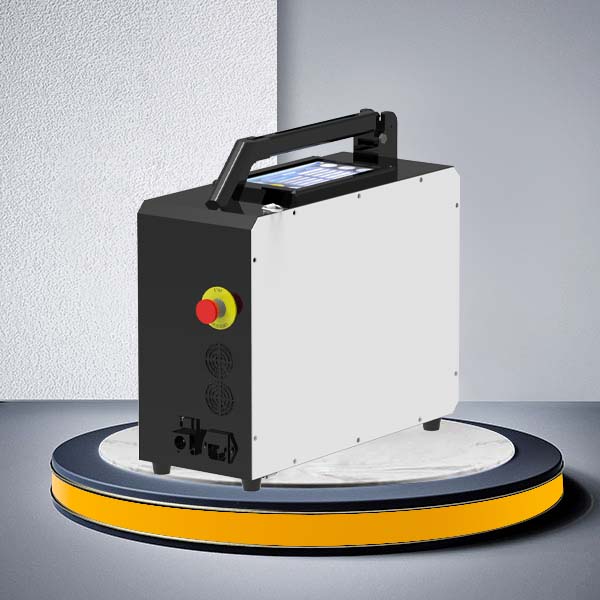
One of the most common applications is laser rust removal.
Metal components exposed to moisture, oxygen, chemicals, or harsh environmental conditions can develop rust and corrosion products. Traditional rust removal methods often involve grinding, abrasive blasting, wire brushing, or chemical treatment.
A portable laser cleaning machine can direct concentrated laser energy onto the contaminated surface. When the process is correctly configured, the rust layer absorbs the laser energy and is removed while the underlying metal can remain comparatively less affected.
This makes the technology useful for:
Steel structures
Metal machinery
Pipes
Automotive parts
Industrial equipment
Metal tools
Fabricated components
Maintenance and repair work
The correct laser parameters depend on the rust thickness, substrate material, surface condition, and required cleaning level.
A Portable Backpack Laser Cleaning Machine can also be used to remove unwanted paint and coatings from metal surfaces.
This is useful when manufacturers or maintenance teams need to prepare a surface for:
Repainting
Welding
Inspection
Repair
Recoating
Surface treatment
Laser cleaning can selectively remove coatings from defined areas, making it suitable for applications where precise cleaning is required.
Compared with abrasive methods, laser cleaning does not require blasting media such as sand or other abrasive materials. This can simplify material handling and reduce secondary contamination.
Industrial equipment can accumulate oil, grease, carbon deposits, and other contaminants during operation.
A portable laser cleaning system can be used for localized cleaning of suitable metal surfaces before maintenance, inspection, welding, or further processing.
For example, maintenance workers may need to clean a contaminated component without removing the entire assembly from the production line. A backpack-style system can provide greater flexibility in these situations.
Laser cleaning is increasingly used around welding operations.
Before welding, contaminants such as oil, rust, paint, oxide layers, and dirt can negatively affect the welding process. Cleaning the joint area can help establish a more suitable surface condition.
After welding, laser cleaning can also be used for certain applications involving:
Weld discoloration
Oxide layers
Surface contaminants
Localized post-weld cleaning
The non-contact nature of laser cleaning allows operators to clean specific areas without using grinding wheels or abrasive tools.
A clean surface is important for many manufacturing processes.
Before welding, bonding, painting, coating, or other surface treatments, manufacturers may need to remove contaminants from the substrate.
A portable laser cleaning machine can provide localized surface preparation without requiring the entire component to be moved to another cleaning area.
This is particularly useful for large equipment and fixed installations.
The portability of a backpack laser cleaner becomes especially valuable when cleaning large objects.
Examples include:
Industrial machinery
Steel structures
Large metal frames
Storage equipment
Pipes
Construction equipment
Ship components
Heavy machinery
Moving a large component to a cleaning machine can require cranes, forklifts, transportation, and additional labor. Instead, operators can bring the cleaning system directly to the component.
This is one of the main reasons manufacturers and maintenance teams consider portable laser cleaning equipment.
Molds can accumulate contaminants, residues, oxidation, and other deposits during repeated production cycles.
Laser cleaning can be used for selected mold-cleaning applications because the process is contactless and can provide controlled cleaning around detailed surfaces.
Potential applications include molds used for:
Plastic products
Rubber products
Die casting
Automotive components
Industrial manufacturing
The appropriate laser type and parameters should be selected according to the mold material, contamination, geometry, and required surface condition.
Portable laser cleaning machines can support selected automotive maintenance and restoration tasks.
Potential applications include cleaning:
Engine components
Metal brackets
Brake components
Automotive molds
Chassis components
Rusted metal surfaces
Paint from selected metal parts
The portable format is useful when components are large or when only a localized section needs to be cleaned.
For restoration work, laser cleaning can also offer greater control than aggressive mechanical abrasion, although process testing is recommended for sensitive or valuable surfaces.
Construction and infrastructure projects often involve large metal structures that cannot easily be transported to a factory cleaning station.
A portable backpack laser cleaner can be brought directly to the work area for suitable surface-cleaning tasks.
Potential applications include:
Steel beams
Metal structures
Bridges
Construction machinery
Pipes
Industrial facilities
Metal frameworks
The exact suitability depends on site conditions, contamination type, laser safety requirements, and the material being cleaned.
The main advantage of a backpack laser cleaning machine is mobility.
Traditional laser cleaning systems can be relatively stationary because the laser source, worktable, control system, and other components are designed around a fixed workstation.
A backpack configuration focuses on portability and operator mobility.
Operators can carry the equipment between different work areas instead of moving large workpieces.
The machine can be used directly at maintenance locations, workshops, production areas, or other suitable sites.
Operators can move around large or irregularly shaped workpieces and clean different sections without repositioning the entire component.
Large components do not necessarily need to be transported to a dedicated cleaning station, potentially reducing handling time and associated labor.
Different cleaning technologies have different advantages. A backpack laser cleaning machine is particularly attractive when precision and mobility are important.
| Cleaning Method | Contact | Consumables | Precision | Portability |
|---|---|---|---|---|
| Laser Cleaning | No | Low | High | High with backpack systems |
| Grinding | Yes | Abrasive tools | Moderate | High |
| Sandblasting | No | Abrasive media | Moderate | Moderate |
| Chemical Cleaning | No | Chemicals | Application-dependent | Moderate |
| Wire Brushing | Yes | Brushes | Moderate | High |
Laser cleaning does not replace every conventional cleaning process. Instead, it provides an additional solution for applications where non-contact processing, controlled cleaning, reduced consumables, and mobility are important.
The machine generates a laser beam and directs it through an optical system toward the contaminated surface.
When the laser interacts with the contamination, the absorbed energy can cause the unwanted layer to rapidly heat, vaporize, fragment, or detach from the substrate, depending on the laser type and process parameters.
The operator moves the laser cleaning head across the target surface. Parameters such as laser power, scanning speed, frequency, pulse width, focal position, and scanning pattern can be adjusted according to the application.
The objective is to remove the unwanted material while maintaining the desired condition of the underlying substrate.
Portable laser cleaning machines are commonly considered for metal substrates such as:
Carbon steel
Stainless steel
Aluminum
Copper
Iron
Galvanized steel
Certain metal alloys
However, not every material or contamination combination can be processed using the same settings. Reflectivity, thermal conductivity, coating thickness, substrate sensitivity, and contamination characteristics all influence the cleaning process.
Testing representative samples before large-scale production is therefore an important part of machine selection.
A Portable Backpack Laser Cleaning Machine is primarily designed for flexible, on-site, and localized surface cleaning. It can be used for applications such as rust removal, paint stripping, oxide removal, oil and grease cleaning, weld preparation, mold cleaning, and industrial equipment maintenance.
Its greatest advantage is mobility. Instead of transporting large or fixed workpieces to a cleaning station, operators can carry the laser cleaning system directly to the work area.
For maintenance teams, metal fabricators, construction companies, automotive manufacturers, and industrial service providers, the backpack format can provide a practical solution when portability, precision, reduced consumables, and non-contact cleaning are key requirements.
0
0
0
All Comments (0)
Previous: None
Next: « Les lasers de déchiffrage machine : Révolution technologique ou menace pour notre patrimoine ? »
If you are interested in sending in a Guest Blogger Submission,welcome to write for us!


Comments